Register for part 2 of our Device Identity Webinar Series!

Enforce SaaS access with device identity

User credentials alone aren’t enough. Smallstep adds device identity to every SaaS login by verifying hardware-bound certificates, ensuring access is tied to trusted, company-approved machines. The same controls protect internal copilots, AI admin consoles, and MCP-enabled SaaS tools, even when passwords or sessions leak.

background gradientbackground texture
MFA Fatigue IconReduce MFA fatigue
Certificate iconEliminate credential theft
List iconSane defaults out of the box
IDP integration
Easy onboarding & offboardingEasy onboarding & offboarding
Cross-platform coverageCross-platform coverage

SMALLSTEP ENTERPRISE RELAY

Protect SaaS apps with Smallstep Relay

Smallstep Enterprise Relay ensures only your company-owned devices can access SaaS and private network resources. Leveraging standards-based private MASQUE relay servers [RFC9298], hardware-attested device certificates, and mutual TLS, Smallstep provides the highest level of assurance that only authorized endpoints reach sensitive resources. Compatible with any SaaS app supporting IP allow lists, Smallstep Enterprise Relay makes enforcing trusted device policies simple and secure.

Enterprise Relay diagram

A fast, secure replacement for traditional VPNs

Smallstep Enterprise Relay proxies traffic only for the domains you specify—like Salesforce or GitHub—routing them through a dedicated tunnel. This precision approach replaces broad VPN subnets with granular, app-level controls, preventing lateral movement and improving security while streamlining connectivity.

Protect GitHub

Granular Zero Trust access

Smallstep Enterprise Relay proxies traffic for a set of domains, letting you specify exactly which SaaS apps (for example, salesforce.com or github.com) must pass through a dedicated tunnel. This method prevents lateral movement and replaces broad VPN subnets with precise, app-level controls.

Hardware-bound credentials

Enterprise Relay works with SaaS IP allowlists. Outbound traffic is restricted to your managed egress IP. Each user device gets a short-lived certificate pinned to its hardware (TPM, Secure Enclave), blocking unauthorized endpoints or personal machines from sneaking into your SaaS apps.

Cross-platform security

Built on modern standards (QUIC and MASQUE), Smallstep Enterprise Relay reduces latency and avoids TCP bottlenecks.The client is built into iOS and macOS, and extends coverage to Windows and Linux through a Smallstep agent. The result is secure connectivity without extra steps.

Relay + Smallstep

Get the data sheet

Smallstep Enterprise Relay ensures only your company-owned devices can access SaaS and private network resources. Compatible with any SaaS app supporting IP allow lists, Smallstep Enterprise Relay makes enforcing trusted device policies simple and secure.

Download
background gradient

SMALLSTEP OKTA INTEGRATION

More secure logins with Smallstep + Okta®

Combining Smallstep and Okta® offers the strongest possible guarantee that your protected SaaS apps are only available on trusted devices. Access is bound to the specific device and cannot be exported. This enables you to require authorization of the user and device before granting access.

Smallstep device attestation workflow - enrolling device through platform verification resulting in locked or approved status - hardware-bound certificate issuance decision flow

Add hardware-based device trust to your existing SSO

Solutions like Okta® Device Trust are great, but in practice they still rely on SCEP certificates which can be exfiltrated. When you integrate Smallstep with your IdP, you gain an extra layer of security that authenticates the trusted device at all times.

Learn more
Protect Okta with mTLS

High assurance device factor

Smallstep works with Okta as an external IdP factor, verifying the user’s hardware certificate before granting access. If the device is valid, the sign-in proceeds quietly. If not, the user is prompted to install or update the Smallstep app. This goes beyond standard MFA or YubiKeys by binding both user and device identity.

Hassle-free setup and SCIM sync

Smallstep integrates with Okta via OIDC, requiring no special configuration beyond standard SSO. SCIM automatically maps each Okta user to Smallstep, streamlining certificate issuance. Users see no extra prompts—just an invisible check confirming the device is cleared for access.

Immutable hardware bindings

By anchoring keys to a device’s secure enclave or TPM, Smallstep eliminates the risk of credential theft. Even if someone gains user credentials, they can’t access apps without the validated hardware. Unlike YubiKeys (which can be misplaced or shared), Smallstep locks down both user and device identity, cutting off attackers who try to reuse stolen tokens on different machines.

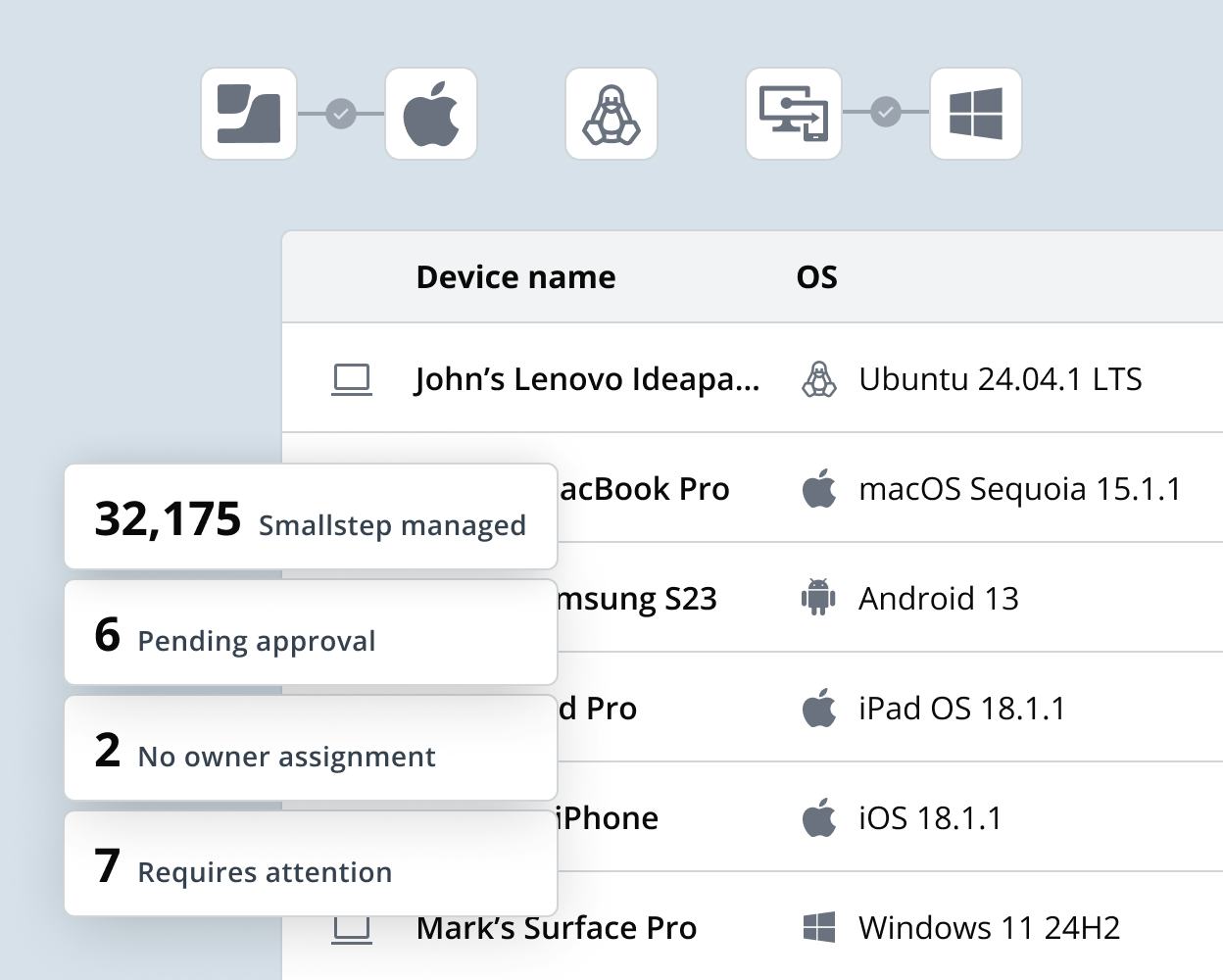
Device inventory list UI

Learn more about the platform

The Smallstep platform helps mitigate numerous cybersecurity threats – from phishing to advanced hardware attacks – without impacting end-user workflows.

Learn more

Leading the industry in Zero Trust for devices

Empower your teams to work at the pace and scale of modern engineering.

Book a demo

FAQs SaaS Apps

Most SaaS access is governed solely by user identity through SSO, which leaves a critical blind spot: the device itself is rarely verified in a meaningful way. That gap allows attackers to steal browser cookies or SAML and OIDC tokens, replay OAuth access tokens from unmanaged machines, hijack sessions on compromised devices, use personal laptops to access corporate SaaS, or bypass conditional access with spoofed posture data.

Smallstep closes this gap by making hardware-attested device identity a required part of SaaS authentication. A login succeeds only when the user is authenticated by the IdP, the device cryptographically proves its identity to Smallstep, and policy explicitly allows that user–device pair. This prevents token theft, replay, and device impersonation from translating into SaaS access.

Smallstep inserts cryptographic device verification directly into the SSO login flow without changing how SaaS applications authenticate users. When a user accesses a SaaS app, the request is redirected to the IdP, and the browser presents a hardware-backed mTLS certificate issued by Smallstep. The IdP validates that certificate with Smallstep before issuing any token.

Only if the device is attested, compliant, and authorized does the IdP complete authentication. The result is that stolen credentials or tokens are useless on any other device—they are cryptographically bound to the original, trusted hardware.

No. Smallstep is not an IdP, and it doesn’t replace one. Your existing IdP continues to authenticate users and manage credentials, groups, and lifecycle.

Smallstep’s role is to authenticate devices and provide cryptographic proof of their identity. Policies then combine user and device identity to authorize each session. The existing IAM architecture and user workflows remain intact, but the security of authentication is materially upgraded.

Token theft is one of the most common and damaging attack vectors in modern environments. Smallstep neutralizes it by requiring a hardware-bound certificate as part of the login process.

A stolen token cannot be replayed from another device because the attacker does not possess the device’s TPM or Secure Enclave private key, and renewal always requires fresh attestation. Even if an attacker exfiltrates all browser session data, they still cannot reproduce the required mTLS handshake needed to authenticate.

Certificates are issued through ACME Device Attestation, which anchors identity directly in hardware. The device generates a non-exportable private key, the TPM or Secure Enclave signs an attestation statement, and Smallstep verifies the hardware identity before checking inventory and posture.

Only then is a short-lived client certificate issued and installed automatically in the operating system or browser. Renewal always requires repeating hardware attestation, ensuring trust is continuously re-established rather than assumed.

Any application federated through your IdP can enforce device trust once Smallstep is in the login path. This includes platforms like Google Workspace, Microsoft 365 and the Azure Portal, the AWS and GCP consoles, GitHub and GitLab, Salesforce and NetSuite, Slack, Atlassian, Notion, and internal administrative consoles.

Applications that support browser mTLS directly can enforce even stronger controls, but the majority of SaaS applications gain effective device trust enforcement automatically through the IdP integration.

Smallstep automates certificate provisioning across all major platforms so device trust works transparently for users. On macOS and iOS, certificates are stored in the system keychain, automatically used by Safari, Chrome, and Firefox, and delivered through MDM or the Smallstep agent. On Windows, certificates are installed in the Windows Certificate Store and are automatically honored by Chrome, Edge, and Office applications.

On Linux, certificates are exposed through a PKCS#11 interface so Chrome and Firefox can use them, remaining hardware-bound when a TPM is available. Across platforms, no user interaction or manual certificate selection is required—device identity is applied automatically and consistently.

Smallstep policies can enforce precise device trust requirements instead of treating all endpoints the same. Access can be limited to hardware-attested devices, managed devices present in inventory, systems that meet MDM or EDR posture requirements, or specific device groups and roles, with stricter rules applied to high-risk applications like cloud consoles or administrative portals.

This enables clear, enforceable policies such as allowing only attested devices to access admin consoles, permitting contractors to use GitHub but not CRM or finance systems, or requiring managed devices for production access. Sensitive SaaS applications remain accessible only from devices that are explicitly trusted.

Smallstep policies can enforce precise device trust requirements instead of treating all endpoints the same. Access can be limited to hardware-attested devices, managed devices present in inventory, systems that meet MDM or EDR posture requirements, or specific device groups and roles, with stricter rules applied to high-risk applications like cloud consoles or administrative portals.

This enables clear, enforceable policies such as allowing only attested devices to access admin consoles, permitting contractors to use GitHub but not CRM or finance systems, or requiring managed devices for production access. Sensitive SaaS applications remain accessible only from devices that are explicitly trusted.

Yes. Smallstep supports tiered assurance models instead of forcing a single trust level across all access. High-assurance access is reserved for corporate-owned, hardware-attested devices and is required for production systems, administrative tools, and sensitive SaaS applications.

Medium assurance can be applied to certificate-authenticated but non-attested devices such as those used by contractors or partners, while low assurance relies on standard SSO-only access for applications that do not require device trust. Policies enforce clear separation between device types and access levels without complicating user workflows.

No. Smallstep does not replace CASB or SWG—it complements them. CASB and SWG control traffic and user behavior after authentication has already occurred.

Smallstep determines whether authentication is allowed in the first place by enforcing hardware-rooted device identity, mTLS-bound logins, and continuous certificate renewal. This means CASB and SWG only operate on traffic from verified users on verified devices, making their controls more effective.

Smallstep is built for hyperscale environments where identity systems must handle high volume without introducing latency. Its architecture includes distributed, horizontally scalable ACME authorities, global mTLS endpoints, HSM-backed certificate authorities for high-throughput signing, and stateless device attestation services.

Certificate issuance is optimized for short-lived credentials, keeping operations efficient at scale. Login overhead remains minimal, with mTLS adding less than 200 milliseconds to typical SSO authentication flows.

Yes. With Step CA Pro and Run Anywhere, organizations can operate Smallstep entirely under their own control, including on-prem or sovereign CA hierarchies, local attestation services, private mTLS endpoints, customer-managed HSMs, and even fully air-gapped deployments when required.

This deployment model is common in highly regulated sectors such as finance, healthcare, defense contracting, government agencies, and critical infrastructure, where external control planes are not acceptable.