Strengthen Okta Device Trust with hardware-backed identity
Smallstep extends Okta authentication with hardware-backed device identity, ensuring only verified devices can access sensitive apps, AI consoles, internal copilots, and MCP-enabled admin tools.


 Reduce MFA fatigue
 Invisible to end users
  Hardware-bound keys
 Cross-platform coverage
 ACME Device Attestation
 Eliminate credential theft
Where Device Trust falls short
The reality is that passwords, tokens, and posture checks can be valid while the wrong device is in control, which leads to breaches based on personalization attacks.
- Credentials may be exported or cloned depending on configuration across platforms.
- Admins have difficulty separating corporate from personal endpoints with certainty.

Enhance Okta with high-assurance device identity
Smallstep adds hardware-backed, device-attested credentials to Okta, uniting user identity, MDM data, and ACME Device Attestation to ensure only trusted, company-owned devices can access sensitive applications. As an external IdP factor using OIDC and SCIM, Smallstep makes Okta’s definition of a “trusted device” far more precise, secure, and resistant to spoofing.

Okta FastPass isn’t device identity
FastPass gives you phishing-resistant, passwordless login with helpful device posture checks. But posture signals aren’t the same as proving which device is accessing your apps.
- Posture and management signals come from software that can be cloned, spoofed, or replayed.
- Session artifacts can be stolen and used from another machine.
- There’s no cryptographic proof that the login is bound to a specific hardware device.
Using ACME Device Attestation, Smallstep issues hardware-bound, non-exportable credentials tied to TPM/Secure Enclave keys. This creates a provable, tamper-resistant link between the certificate and the exact physical device.

Invisible authentication at access
Smallstep integrates as an external device identity check using standard OIDC and mTLS. This authentication is invisible to end users, reducing MFA fatigue. Your Okta tenant remains the source of truth for users, groups, and app policies.

Okta integrates seamlessly with Smallstep
The device’s secure element creates a hardware-bound key. Smallstep issues a device-attested credential where supported by the platform. The user signs into Okta as usual. Okta routes the request through Smallstep for device verification. If both user and device checks pass, access to the app is granted.
Okta continues to manage users, MFA, and app assignments. Smallstep verifies hardware-backed device credentials as part of SSO.
Only devices that can prove their identity in hardware can reach protected Okta apps.
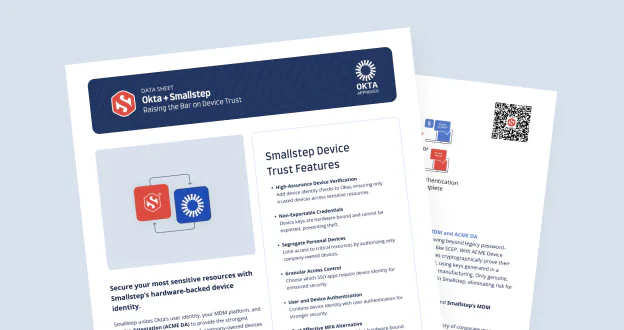
Get the data sheet
Smallstep unites Okta’s user identity, your MDM platform, and Device Attestation (ACME DA) to provide the strongest possible guarantee that only trusted, company-owned devices can access critical applications and resources.

Key benefits for Okta customers
Hardware-backed device identity
Use TPM or Secure Enclave to bind credentials to real hardware. Keys are non-exportable and tied to the device.

Cross-platform coverage
Support hardware-backed keys on Windows, macOS, Linux, and ChromeOS, with attestation on supported platforms and supervised Apple devices.

Granular app enforcement
Decide which Okta-protected applications require device proof, so you can reserve stricter controls for your highest-risk systems.
Seamless user experience
Device checks run in the background. Users keep the same Okta login flow and don’t have to manage extra tokens or prompts.
Cleaner device boundaries
Segment access between corporate and personal devices by enforcing hardware-bound credentials issued only to known, managed endpoints.

Stronger defense in depth
Combine user identity, strong MFA, and device identity in one flow to reduce the impact of credential theft or session hijacking.
Use Smallstep to strengthen device trust for the Okta-federated systems that carry the most business risk.
Passwords, tokens, and posture checks can’t guarantee that the device accessing Okta apps is trusted. Hardware-backed keys and attestation dramatically raise the bar against attackers. Add cryptographic device proof to your Okta SSO flow and keep your most sensitive apps on trusted hardware.