Certificate lifetimes are collapsing. Manual renewal is what breaks first.
Public certificates now expire every 200 days, and every 100 from March 2027. Smallstep is a private CA: we don’t issue public certificates. We take the internal endpoints you’ve been putting public certificates on (RADIUS, VPN, internal web, devices) off that clock entirely, with hardware-bound certificates that renew themselves at whatever lifetime you choose.


 Short-lived by design
 Enrollment over ACME device-attest-01
 Hardware-bound, non-exportable keys
 Unattended renewal at any frequency
 Searchable issuance records
 Fits your MDM and IdP

Renewal used to be a yearly chore. It is becoming a six-week one, and across a fleet it never stops.
Most teams still treat renewal as annual maintenance: track a spreadsheet, file a change ticket, generate a CSR, revalidate, install, confirm. That holds when a certificate lasts a year. The CA/Browser Forum ratified Ballot SC-081v3 in April 2025 with no votes against, and the reductions run from March 2026 to March 2029.
- Until March 15, 2026: 398-day certificates
- Now: 200 days, with domain validation reused for up to 200 days
- From March 15, 2027: 100 days, with 100-day validation reuse
- From March 15, 2029: 47 days, with 10-day validation reuse

The work scales with the frequency, unless there is no work.
Every renewal the schedule adds is either a ticket someone runs by hand or an event nothing has to touch. Automated issuance handles a 47-day cycle at the same operational cost as an annual one, which is why the wall arrives for manual processes and not for automated ones.
It is already arriving: one university’s RADIUS certificates on Cisco ISE went from annual renewal to every four months, which is what put a private CA on their shortlist.
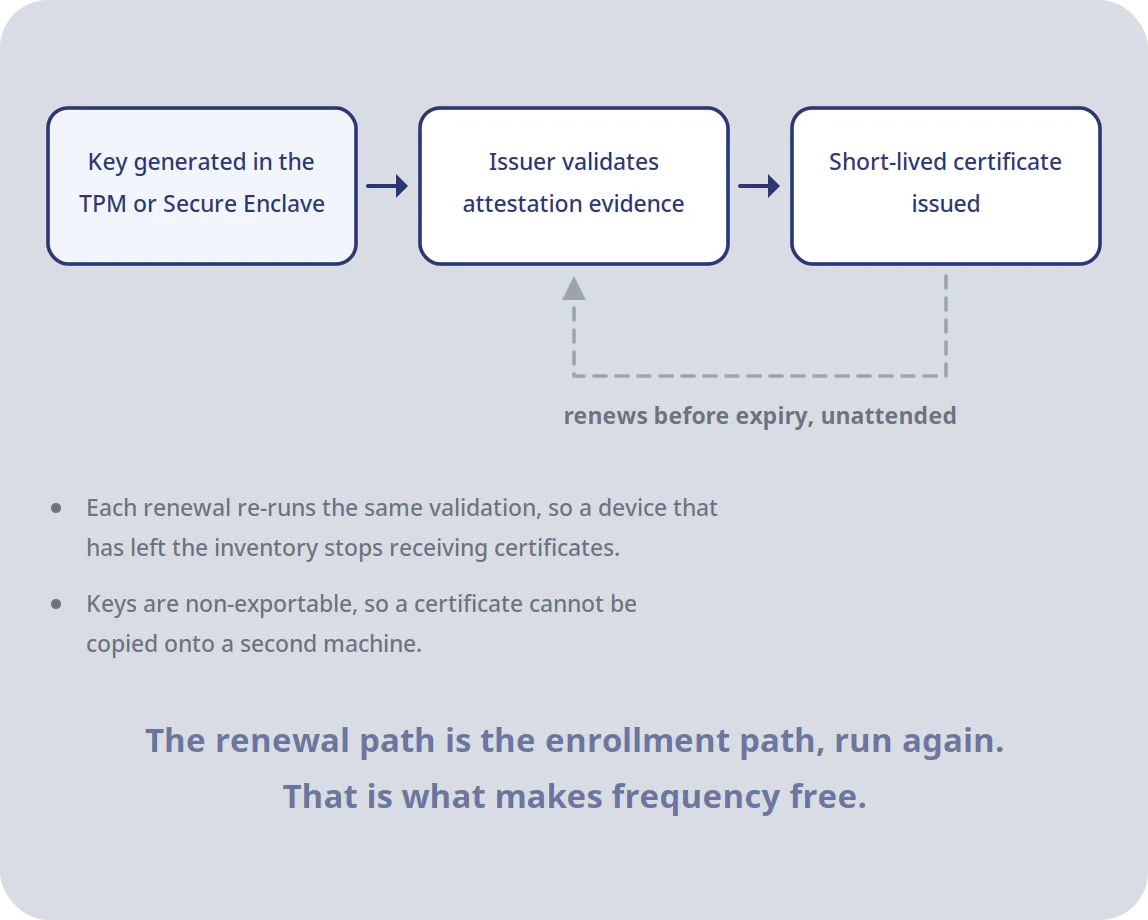
Hardware-attested issuance, renewed without a person in the loop.
The private key is generated inside the device’s TPM or Secure Enclave and never leaves it. Enrollment uses ACME device-attest-01, the IETF standard whose design credits Smallstep’s implementation experience, so the issuer validates hardware evidence rather than a shared SCEP challenge phrase anyone can copy.
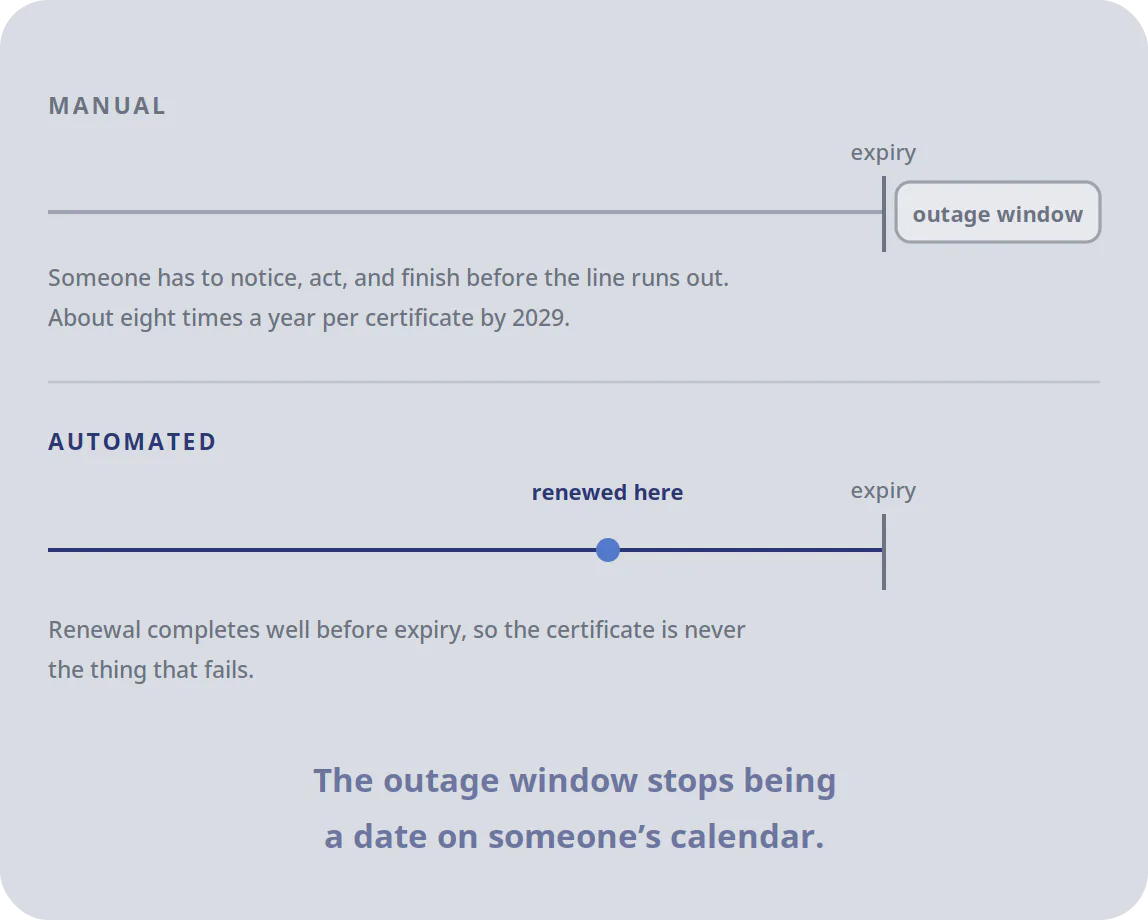
A certificate that renews itself cannot lapse because someone missed a date.
Most certificate outages trace to a missed date. Unattended renewal removes the window entirely, and because every issuance ties to a user and an enrolled device, audits and incident reviews have one place to look instead of a spreadsheet.
What the 47-day era costs you in labor
Estimate the engineer time manual renewal consumes as certificate lifetimes shrink. Move the inputs to match your environment.
7.8 renewals per certificate a year — 4.3x the volume of today’s 200-day cycle.
Illustrative estimate. Manual labor is modeled as certificates × renewals per year (365 ÷ certificate lifetime in days) × handling minutes × hourly cost. Your actual figures depend on discovery, validation, and install effort per certificate.
Manual renewal labor per year
$1.1M
At 47-day lifetimes, with these settings
$15,000 a minute
And that is only labor. A missed renewal is an outage, and Splunk puts the average cost of downtime at $15,000 per minute. Unplanned downtime now costs Global 2000 companies $600 billion a year. Source: Splunk, The Hidden Costs of Downtime, 2026.
Bring your certificate count and where those certificates live. We will show which endpoints can move to private, automated issuance.
Talk to salesIllustrative estimate. Manual labor is modeled as certificates × renewals per year (365 ÷ certificate lifetime in days) × handling minutes × hourly cost. Your actual figures depend on discovery, validation, and install effort per certificate.
See what automated issuance saves you.
Bring your certificate count and where those certificates live. We will show which endpoints can move to private, automated issuance and where the labor and the outage risk go.