Keep your existing CA. Add verified device identity.
Your PKI stays in place, in AD CS, HashiCorp Vault, AWS Private CA, Google CAS, or EJBCA. Smallstep adds device-aware issuance: enrollment authorization against inventory, hardware-backed credentials where supported, and automated lifecycle. A Smallstep intermediate beneath your existing CA preserves your trust hierarchy while you gain control over which devices receive access credentials.


 Chains to AD CS, Vault, AWS Private CA, Google CAS, EJBCA
 Your CA key is never uploaded to Smallstep
 Issued only to approved inventory
 Hardware assurance where supported
 Your CA keeps issuing as before
 Automated certificate lifecycle

Your CA enforces issuance policy. Smallstep adds device enrollment and lifecycle controls.
AD CS, Vault, AWS Private CA, Google CAS, and EJBCA already control what they issue, through templates, roles, IAM, and issuance policies. Smallstep complements that by tying issuance to approved device inventory, enrollment workflows, and cryptographic device evidence where supported. Your PKI keeps the trust hierarchy; Smallstep manages which devices are eligible to receive and renew access credentials.
- Your PKI team keeps the root, its ceremony, and its policies. Smallstep runs the device-facing issuer.

Your PKI integrates with Smallstep at one point: a signed intermediate
Upload your root certificate, never the key. Smallstep generates the intermediate key in its HSM and hands you a CSR. Sign it with the CA authorized to issue subordinate CAs in your PKI; the guide covers signing from an existing root, with commands for AD CS, Vault, AWS Private CA, OpenSSL, and CFSSL, and multi-tier chains should be confirmed with us. Upload the signed certificate. The authority is live, and every certificate it issues chains to your root.

Trust the root, but key policy on the issuer
Smallstep certificates chain to your trusted root, so you generally need no new trust anchor. Relying parties still enforce their own profile, issuer, and identity-mapping rules, and a root-only rule also accepts every other intermediate beneath it. Configure each relying party to require the intended issuing CA and the certificate's purpose and identity.
- Issuer tells you who signed, not what assurance applied. Where assurance levels differ, use separate issuing authorities or an attribute that identifies the policy.
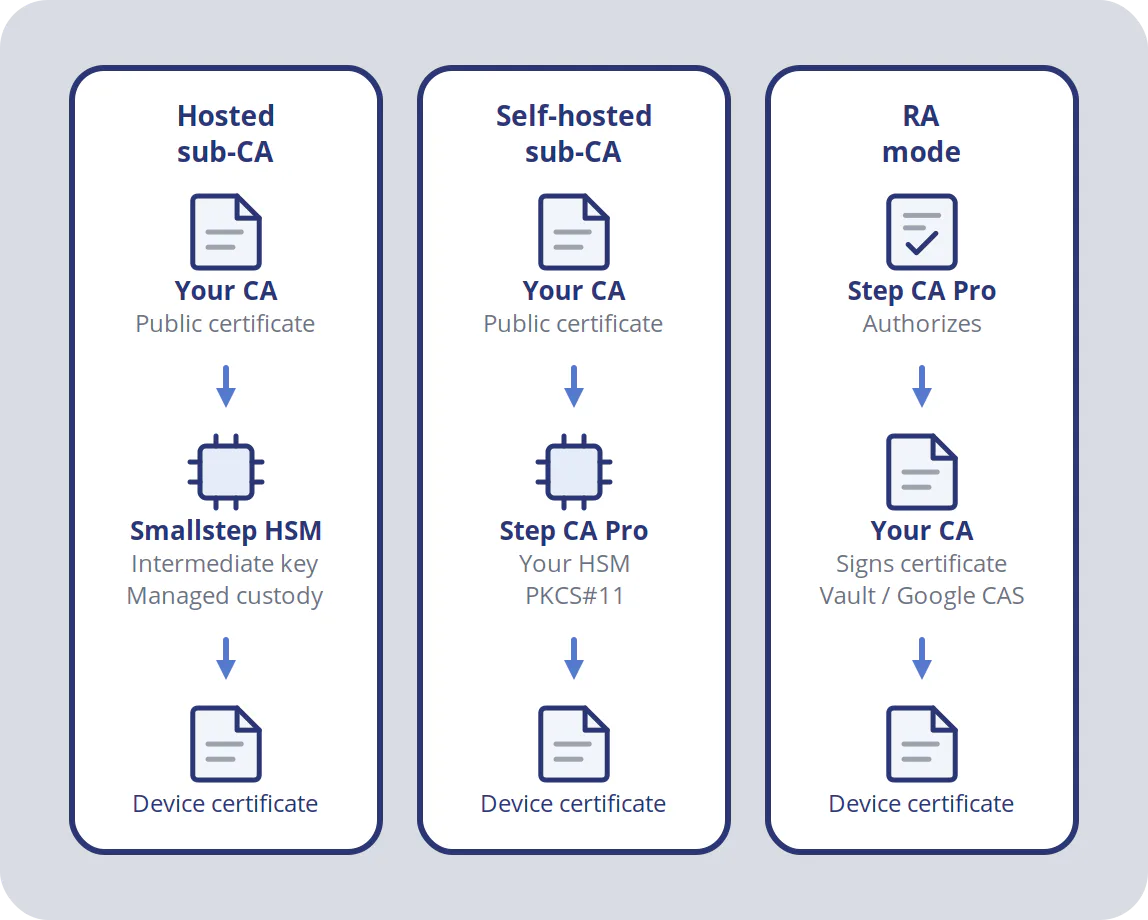
Three ways to fit your PKI
Subordinate CA, hosted: Smallstep holds the issuing intermediate key in its managed cloud HSM; your CA key stays with you. Fits teams that want a managed device issuer under their hierarchy. Subordinate CA, self-hosted: Step CA Pro on your infrastructure with a supported PKCS#11 HSM, for key custody requirements. Registration authority: Step CA Pro authenticates and authorizes requests while Vault or Google CAS keeps the key and signs the leaf, for teams that must keep all signing in the existing CA.

Smallstep manages device issuance. Your PKI stays the root of trust.
Your CA keeps issuing what it issues today: server certificates, workload certificates, code signing. With a subordinate CA, Smallstep issues and renews device certificates beneath your trust hierarchy, can publish CRL and OCSP for them on authorities with active revocation, and stays out of your CA's other workflows. In RA mode, Smallstep authorizes device requests and your CA signs them.
Your PKI owns the trust anchor, the signing CA, and revocation of the intermediate. Smallstep owns which devices get a credential and how its key is protected.
Key benefits for teams with an existing PKI
Root key stays where it is
You upload a certificate and sign one CSR. Your CA private key stays under your control and is never uploaded to Smallstep; the intermediate can be revoked or rotated from your CA.
Certificates for authorized devices
Smallstep enforces the configured inventory, approval, and enrollment requirements before issuing. Hardware attestation applies where the platform supports it and the selected workflow requires it.
Device identity assurance matched to each platform
TPM-based attestation on compatible Windows and Linux devices; Secure Enclave and managed-device workflows on Apple devices, each with its own assurance level. The relying party sees it as a certificate under your root.
No new trust anchor
Certificates chain to the root your relying parties already trust. Each still applies its own profile, issuer, and identity rules; set those to the Smallstep issuer where assurance matters.

One identity, more than one enforcement point
The same device identity can serve Wi-Fi, VPN, ZTNA, and SSO integrations, each with its own credential configuration and enforcement; SSH uses a separate authority outside the X.509 hierarchy.
Lifecycle that follows inventory
Short lifetimes, automatic renewal, and issuance that stops when a device leaves inventory; an existing certificate is not invalidated by removal alone. Revocation of the intermediate itself stays with the CA that signed it.
Put verified device issuance under the root you already run.
Your PKI keeps the trust hierarchy. Smallstep governs which devices receive a certificate beneath it and how its key is protected.