Keyfactor governs the certificate estate. Smallstep decides which devices can use it.
Keyfactor governs the certificates you have. Smallstep proves which devices should get one, with hardware evidence before issuance.


 Hardware provenance at enrollment
 Non-exportable, hardware-bound keys
 Authorization against a trusted device record
 Checked at the enforcement point
 Enrollment over ACME device-attest-01
 Evidence from hardware to access

Certificate lifecycle and device trust are different questions.
Lifecycle management asks what happens to a certificate once it exists: discovery, renewal, revocation, governance across every CA in the estate. Device identity asks one step earlier, whether this device should receive a trusted credential at all. A capability can appear in both models, and where it sits relative to issuance decides whether it solves the problem end to end.
- "Nobody knew that certificate existed" is a lifecycle question
- "Can this endpoint prove itself before Wi-Fi or VPN" is a trust question
- Collapsing the two produces the wrong shortlist

Enrollment gated on hardware evidence, not a shared secret
Smallstep checks inventory and attestation evidence before issuance, then completes ACME device-attest-01 with a key generated in the TPM or Secure Enclave. Nothing enrolls on a SCEP challenge phrase anyone can copy.
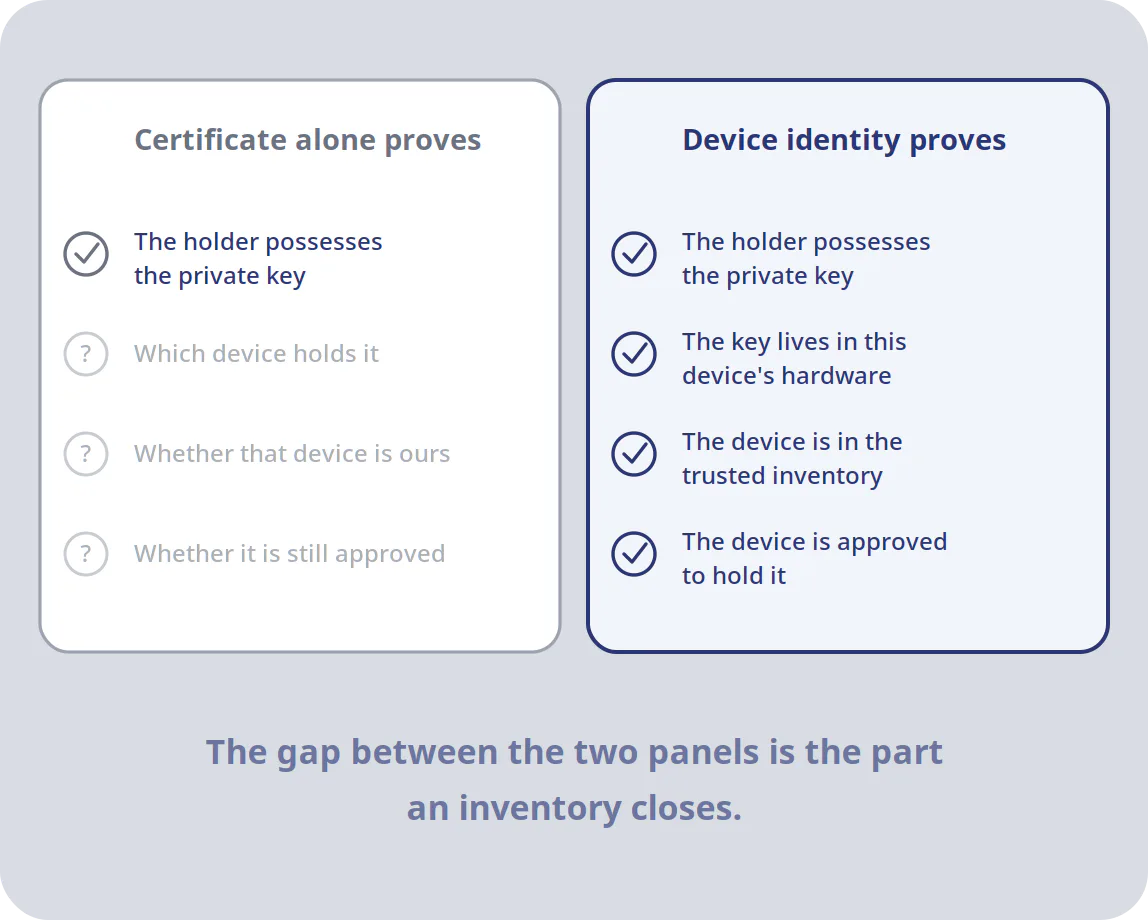
A certificate proves a key. An inventory turns it into an authorization.
A certificate says someone holds the private key. It doesn’t say that key sits in a device you own and approved. Smallstep syncs inventory from Jamf Pro, Intune, Workspace ONE UEM, Mosyle, Iru, Fleet and Google Workspace, or via API, and stops renewing a device’s credentials when it leaves inventory, with active revocation on Advanced Authorities.

Smallstep authorizes issuance. The enforcement point checks the credential.
The two get conflated. Smallstep decides which devices receive and keep a trusted credential, and that one credential gates Wi-Fi, VPN, SSH, internal apps, and SSO. At access time Smallstep is often the checker, through its managed RADIUS (or, where available, its relay). Sometimes it is your ISE or your IdP.

When a certificate lifecycle platform is the right starting point
Governance across many CAs, public or trusted TLS, and document or artifact signing are lifecycle problems, and Keyfactor is built for them. Identity for products you manufacture can start on either side. Many enterprises need both layers. Replacing AD CS? See where each fits.
Keep Keyfactor where it governs. Add device identity where access is decided.
Attested enrollment, authorization against a trusted device record, and an evidence trail from device hardware to the decision that permitted access.