Add verified device identity to Cloudflare Zero Trust
Cloudflare decides who gets access. Smallstep verifies which devices can receive trusted certificates, with hardware-backed assurance where supported, and keeps them renewed. Strengthen device access policies without replacing Cloudflare.


 Works with Cloudflare One Client and Access
 Issued only to approved inventory
 Hardware assurance where supported
 Certificate-based device posture
 Windows, macOS, Linux, ChromeOS
 Automated certificate lifecycle

Cloudflare checks for a certificate. Smallstep decides which devices get one.
The client certificate posture check confirms a device holds a certificate signed by the issuer you upload. It does not ask how the device got it. Smallstep answers that: enrollment is authorized against your Jamf, Intune, or Google inventory, keys are generated in hardware where the platform allows, and renewal stops when a device leaves.
- Cloudflare validates the certificate it is shown. Smallstep governs which devices receive one.
- Your IdP and the Cloudflare One Client stay. You add the check to the Access or Gateway policies that should require it.

Cloudflare integrates with Smallstep at two points
First, the client certificate posture check: upload the Smallstep issuing certificate, enable the private key check, and reference it in Access and Gateway policies. It verifies certificate attributes and that a private key is present; it does not prove possession or hardware residency. Second, Access mTLS: upload the Smallstep CA chain for your protected hostnames and require a certificate alongside IdP login. The TLS handshake proves key possession. Gateway cannot inspect mTLS hostnames, so bypass inspection for them.

Move from serial-number lists to attested identity
Cloudflare's serial-number and device UUID checks compare what a device reports against a list you maintain. A Smallstep certificate is issued only after the device is matched to inventory, using the strongest verification each platform supports: TPM attestation, Apple Managed Device Attestation, ChromeOS Verified Access, or other key protection.
- Issuance follows synchronized inventory; no separate device allowlist.
- Assurance varies by deployment; not every path is hardware-attested.
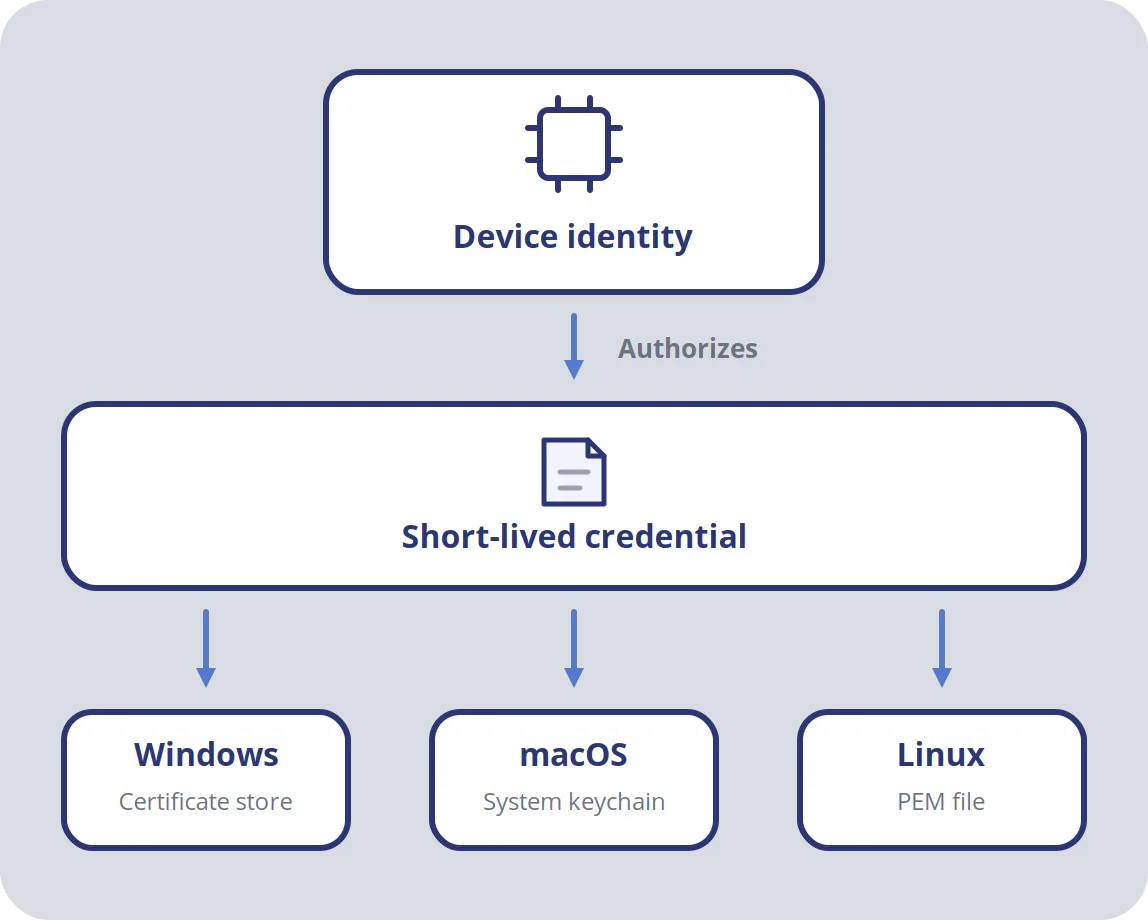
Credentials the Cloudflare One Client can read
The client reads certificates from the Windows store, the macOS System keychain, or a PEM file on Linux, so the key must live where the client can see it. Where that store cannot hold a hardware-bound key, Smallstep can issue, where supported and configured, a short-lived credential authorized by the device's attested identity, and renew it. Security depends on both issuance assurance and credential protection afterward.

Smallstep manages issuance. Cloudflare controls access.
Smallstep authorizes enrollment from your inventory and issues the certificate. The Cloudflare One Client checks it on its polling schedule and Cloudflare applies policy; Smallstep is not in the request path.
Cloudflare owns policy and enforcement. Smallstep owns which devices get a credential and how its key is protected.
Example: Intune-managed laptops enroll through the agent; an Access policy requires the posture check before an internal app loads.
Key benefits for Cloudflare Zero Trust customers

Certificates for authorized devices
Smallstep checks inventory and enrollment policy before issuing. Devices outside your policy cannot obtain those credentials; Cloudflare then enforces access with its configured posture and Access rules.

Hardware attestation where it exists
Smallstep uses TPM attestation, ChromeOS Verified Access, and Apple Managed Device Attestation where supported. Key protection and attestation assurance depend on the OS, enrollment method, and credential configuration.

Keep Cloudflare as the enforcement platform
Add Smallstep-issued certificates to supported posture checks and Access mTLS policies without replacing your identity provider or the Cloudflare One Client.

Nothing for users to carry
Enrollment, issuance, and renewal happen through the agent or MDM. Users pass the posture check with a managed certificate instead of a prompt.

One identity, more than one enforcement point
The same device identity can serve Wi-Fi, VPN, SSO, and SSH integrations, each with its own credential configuration and enforcement on the resource side.
Lifecycle that follows inventory
Issuance and renewal are tied to device authorization. When a device is removed, renewal stops and existing credentials run to their configured expiry. Immediate removal needs enforcement in Cloudflare.
Put issuance assurance behind the Cloudflare policies you already run.
Cloudflare keeps deciding who gets through. Smallstep governs which devices receive a certificate and how its key is protected.